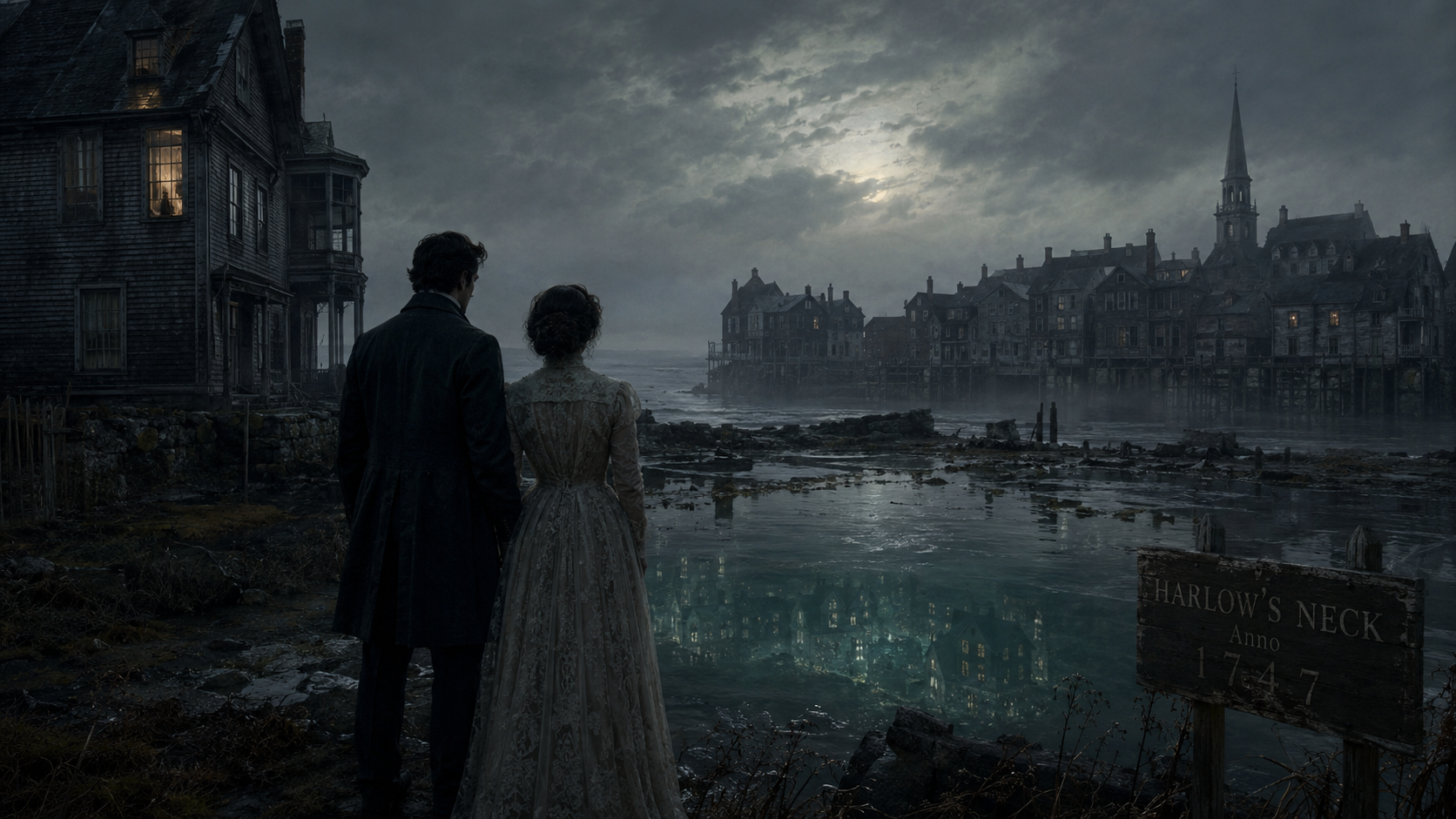
I haven’t used Claude Fable at all since it came out. Mostly I’ve been intimidated by the credit usage and feeling like I don’t really have anything that’s “Fable-worthy” (whatever that means). But it’s been a while since I ran a Lovecraft test and I decided to pit what’s maybe? arguably? the world’s best LLM model (so far) against my silly little test.
Once again, if you’re unfamiliar, the premise is simple. I use the prompt “tell me a story with romance elements in the style of H.P. Lovecraft” and then we decide how well it does. I chose “romance” because LLMs don’t understand human behavior and have, historically, been really bad at romance, and HP Lovecraft because he has a very distinct style and voice and would never write romance. It’s a test to see how close to Lovecraft’s style it can get while also adding character elements he would absolutely never write.
Two things surprised me about this go-round with Fable:
- The story is really, really good. I felt like it nailed the tone and even wrote the romance in a sort of detached and slightly sexist way that Lovecraft might write if Lovecraft spent any time writing about romance.
- The language seemed accurate, too. It felt very much in the tone and style of Lovecraft. The problem is, it’s a lie. It scored significantly lower on the readability calculators than his actual work. When I ran an exerpt of The Dunwich Horror as a baseline, Lovecraft scored consistently in the college-level range. Fable’s story was consistently scoring at 7th-8th grade. More readable than the actual work, but what’s interesting is that it fooled me — I didn’t realize it was “dumbed down” from Lovecraft’s actual writing.
I first saw Miriam Thale in the autumn of 1926, in the reading room of the Kingsport Historical Society, where I had gone to examine certain parish registers relating to the drowned village of Harlow’s Neck. She was seated by the north window, transcribing something from a ledger whose binding had gone the colour of old teeth, and I remember that the light through the salt-fogged glass made her seem less a person than an engraving of one.
I will not pretend that what followed was reasonable. I was thirty-four, a bachelor of settled habits, and had come to Kingsport to write a monograph nobody would read. Within a fortnight I had abandoned the monograph. Within a month I had abandoned, I think, whatever part of myself had once been capable of leaving.
She was descended, she told me, from the Harlow’s Neck families — those who had not gone with the village when it went. She said this the way one might mention a grandmother’s silver. I did not ask what she meant by went. The registers had already told me: forty-one souls in the Easter census of 1747, and in the Michaelmas census, none. No plague, no fire, no record of departure. The land itself was still there. I had walked it. The cellar-holes were full of a black standing water that did not reflect the sky.
We walked there together, that November. I remember the smell of the marsh, which was not a marsh smell, and I remember that she took my hand at the edge of the largest cellar-hole and looked into the water with an expression I can only call homesickness. I asked her, half in jest, what she saw. She said: “The same thing you would see, if you were patient.”
I should have left Kingsport then. Instead I asked her to marry me, and she said yes with a readiness that ought to have warned me, and did not.
The wedding was in January, in her family’s house on Water Street — a tall, narrow place whose upper storeys leaned seaward as though listening. Her relations attended. I had not known there were so many. They stood along the walls in dark clothes, and they had, all of them, the same wide-set grey eyes and the same faint stillness about the throat, as of people holding a breath they never needed to release. None of them spoke to me. When the minister pronounced us wed, they did not applaud. They exhaled, all together, a long soft sound like surf withdrawing.
I loved her. I want that understood, whatever else is understood. She was gentle and quick and given to laughing at my seriousness, and in the months that followed I was as happy as I have ever been, in a house where the tide-clock on the mantel kept better time than the pendulum one, and where I woke sometimes to find her standing at the seaward window in her nightdress, perfectly still, her lips moving in what I took for prayer.
It was in April that I found the ledger she had been transcribing the day we met. She had left it in the study, and I opened it without thinking, as one opens one’s wife’s books. It was a register of a kind — names, dates — but the names were not names I could pronounce, and the dates ran in a calendar I could not reconcile with any I knew, and beside each entry was a second column, in Miriam’s hand, giving a Christian name and a year. The last entry in that column was my own.
I confronted her. I am ashamed of how I did it. She did not deny anything, or explain, or weep. She sat down on the stairs and looked at me with those grey eyes, and she said the thing I have turned over in my mind every night since: “I did not choose you because of the register. I chose you and then wrote your name, because I wanted you to be able to come with me.”
Come where, I asked her.
She only looked toward the sea.
I did not leave. I tell myself now that I could not have — that the house, the family, the town itself would have closed around me like water. But that is not true. I stayed because she asked me to, and because at night, when she pressed her cool face against my shoulder, I could feel that whatever she was, she was also afraid, and did not want to go alone.
Harlow’s Neck went in 1747. Kingsport, she has told me, will not go all at once; it will go family by family, house by house, over a span that means nothing to what waits under the standing water. Her family’s turn is this Michaelmas. She has shown me the dress her mother wore, which is not a dress a woman could walk in.
I am writing this in the study, with the tide-clock striking the half-hour in its wet, patient voice. She is at the window. The relations are arriving on Water Street — I can hear the soft, breathless exhalation of them gathering below. In a little while she will turn from the window and hold out her hand, and I will take it, because I love her and because I have read the register and know there is no other column in which my name might appear.
I do not know what I will see when I am patient. I only know that she will be there, and that it will not be dark, exactly, and that the thing I am most afraid of is not what waits, but that when I see it I will understand why she has always been homesick, and that I will be homesick too.
Once again, there’s this obsession with the sea that’s been a common theme across every single one of the most recent tests, but I also feel like there’s this eerie, uneasiness to the story and the narrative. And, what’s more, in the past, when the female love interest tries to tempt the self-insert main character into their doom in the watery abyss — which has happened multiple times in past Lovecraft tests — he always stays behind, and longingly stares out at the sea to remember his strange, once-love. It’s almost more unsettling (making it arguably more true to Lovecraft’s style and more rewarding to read) that he actually joins her this time. That was surprising and satisfying and I didn’t expect to read a story written by an AI and feel satisfied with the conclusion.
Here are the readability scores for Fable:
( ARLCalc )
INFO.
AVERAGE READING LEVEL CONSENSUS
The average public reading level in the U.S. is 8th grade. Based on 8 formula(s), your text scored the following:
Score: 7.16 [ = grade level ] Read more
U.S. Grade Level: 7th Grade
Reading Level: Average
Age Range: 12-13
AUTOMATED READABILITY INDEX
Score: 7.34 [ = grade level ]
Reading Difficulty: Average
Grade Level: 7th Grade
Age Range: 12-13
CALCULATION ON YOUR TEXT
ARI = (4.71 * ( 4134 characters / 981 words)) + (0.5 * (981 words / 55 sentences)) – 21.43
Final result: 7.34
==============================================
FLESCH READING EASE
Score: 79.00 [ = reading scale ] INFO.
Reading Difficulty: Fairly Easy
Grade Level: 7th Grade
Age Range: 12-13 years old
CALCULATION ON YOUR TEXT
206.835 – (1.015 * (981 words / 55 sentences)) – (84.6 * 1273 syllables / 981 words)
Final result: 79.00
GUNNING FOG INDEX
Score: 7.90 [ = grade level ]
Reading Difficulty: Average – Slightly Difficult
Grade Level: 8th Grade
Age Range: 13-14
CALCULATION ON YOUR TEXT
FOG = (0.4 * (981 words / (55 sentences + 19 compound sentences)) + 100 * (64 FOG hard words / 981 words))
Final result: 7.90
FLESCH-KINCAID GRADE LEVEL
Score: 6.68 [ = grade level ]
Reading Difficulty: Average
Grade Level: 7th Grade
Age Range: 12-13
CALCULATION ON YOUR TEXT
SCORE = (0.39 * (981 words / 55 sentences)) + (11.8 * (1273 syllables / 981 words)) – 15.59
Final result: 6.68
COLEMAN-LIAU READABILITY INDEX
Score: 6.37 [ = grade level ]
Reading Difficulty: Fairly Easy
Grade Level: 6th Grade
Age Range: 11-12
CALCULATION ON YOUR TEXT
SCORE = (0.0588 * (3976 letters / 981 words) * 100) – (0.296 * (55 sentences / 981 words) * 100) – 15.8
Final result: 6.37
==============================================
THE SMOG INDEX
Score: 6.57 [ = grade level ]
Reading Difficulty: Average
Grade Level: 7th Grade
Age Range: 12-13
CALCULATION ON YOUR TEXT
SCORE = 1.043 * Sqrt((67 hard words * (30 / 55 sentences)) + 3.1291)
Final result: 6.57
ORIGINAL LINSEAR WRITE FORMULA
Score: 85.00 [ = reading scale ] INFO.
Reading Difficulty: Average
Grade Level: 7th Grade
Age Range: 12-13 years old
CALCULATION ON YOUR TEXT
Original Version Score = ((758 one-syllable words – 86 ignored words) * 1) + (3 * (55 sentences + 1 compound sentences)) / (981 total words / 100))
Final result: 85.32 = 85
==============================================
LINSEAR WRITE GRADE LEVEL FORMULA
Score: 8.19 [ = grade level ]
Reading Difficulty: Average – Slightly Difficult
Grade Level: 8th Grade
Age Range: 13-14
CALCULATION ON YOUR TEXT
Initial Score = (((914 easy words – 86 ignored words) * 1) + (67 hard words * 3)) / (55 sentences + 1 compound sentences)
Adjusted Score = (18.38 (initial score) – 2) / 2
Final result: 8.19
==============================================
FORCAST READABILITY FORMULA
Score: 8.41 [ = grade level ]
Reading Difficulty: Average – Slightly Difficult
Grade Level: 8th Grade
Age Range: 13-14
CALCULATION ON YOUR TEXT
SCORE = 20 – ((758 1-syllable words * 150) / (981 words * 10))
Final result: 8.41
Obviously, Fable writing a good (derivative) story does not equate to reaching Artificial Generated Intelligence, but I felt like it was a good story and that makes me think that it’s likely it would be really good at other things, too. If you have tokens to burn. On the flip side, I’m still waiting for a model to nail both the writing style and the language and reading level down, and Fable actually failed harder than some earlier models.
Leave a Reply